A cash counting machine is one of those purchases you make once and live with for years. Pick one that is too basic and your staff end up recounting by hand. Pick one that is too complex and you pay for features nobody uses. This guide walks through the questions we ask every customer before recommending a machine, so you can work out what you need before you talk to anyone.
1. How many notes do you count each day?
Volume is the starting point, because it decides how fast and how robust the machine needs to be.
- Up to about 2,000 notes a day (small shops, pharmacies, restaurants): a compact single-pocket counter is usually enough.
- 2,000 to 10,000 notes a day (supermarkets, finance company branches, busy retailers): look for a faster mixed-value counter with a larger hopper, so staff can load a full bundle at once.
- More than 10,000 notes a day (bank branches, cash centres, CIT operations): a two-pocket or multi-pocket sorter will save hours each week, because it can separate notes while it counts.
Speed figures such as “1,500 notes per minute” are useful, but hopper size matters just as much. A 500-note or 600-note hopper means fewer stops to reload.
2. Do you count one denomination at a time, or mixed bundles?
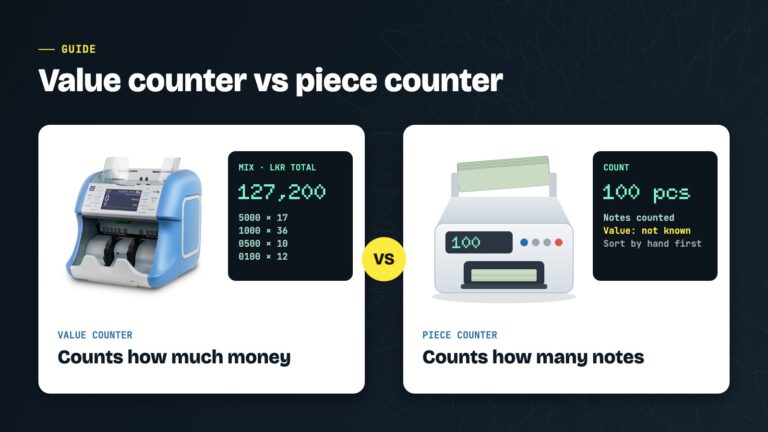
This is the single biggest decision. A piece counter counts how many notes are in a stack. A value counter (also called a mixed-value counter) recognises each note’s denomination and gives you the total value of a mixed bundle, with a breakdown by denomination.
If your cashiers hand over end-of-shift takings with Rs 5,000, Rs 1,000, Rs 500 and Rs 100 notes mixed together, a value counter removes the sorting step entirely. We explain the difference in detail in Value counter vs piece counter: which do you need?
3. How good does counterfeit detection need to be?
Most counters check notes with several sensors. The common ones are:
- UV (ultraviolet): genuine notes react to UV light in a specific way; many fakes printed on ordinary paper do not.
- MG (magnetic): checks the magnetic ink used in parts of genuine notes.
- IR (infrared): checks patterns that only show under infrared light.
- CIS (contact image sensor): scans an image of each note and compares it with the genuine note. Machines with dual CIS scan both sides.
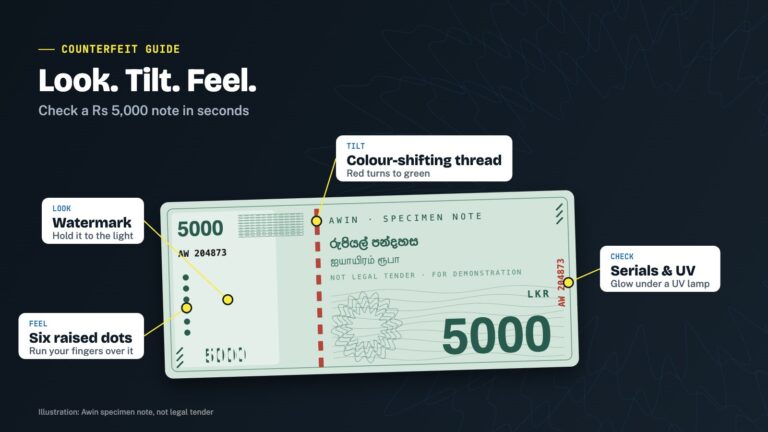
For a business that occasionally receives large notes, UV, MG and IR are a good baseline. If you handle high volumes of Rs 5,000 notes, or you are a bank, choose a machine with CIS image recognition. Our guide How to spot a fake Rs 5,000 note explains which features a person can check by hand and which ones a machine checks.
4. Do you need serial numbers recorded?
Banks, finance companies and businesses that need an audit trail often want the serial number of every note saved. Machines with serial number recognition (OCR) read and store serials, so a suspect or disputed note can be traced back to a transaction. If you don’t need this today but expect to, it is cheaper to buy a machine that has it than to replace one later.
5. Do you handle foreign currency?
Hotels, money changers and businesses that accept US dollars, euros or other currencies need a machine that supports those currencies and can be updated. Check how many currencies the machine supports and whether it can switch between them automatically.
6. Can it be updated when a new note is issued?
The Central Bank of Sri Lanka issues new and commemorative notes from time to time. A machine that cannot be updated will start rejecting genuine new notes. Ask how updates are installed (usually by USB or by a technician) and who will do it for you.
7. Who will service it?
Every counting machine collects paper dust and needs its sensors cleaned and calibrated. The best machine is the one that someone local can keep running. Before you buy, check:
- Is the seller an authorised distributor for the brand?
- Are genuine spare parts available in Sri Lanka?
- Can a technician reach your branches outside Colombo?
- Is installation and operator training included?
At Awin Trading we only sell brands we service ourselves. You can read more about how we look after machines on our Service & Repair page.
A quick way to match needs to machines
| Your situation | What to look for |
|---|---|
| Small business, one denomination at a time | Compact counter with UV, MG and IR |
| Mixed takings at the end of each shift | Mixed-value counter with CIS |
| Branch counter, audit trail needed | Value counter with serial number recognition |
| High volume, notes need separating | Two-pocket sorter |
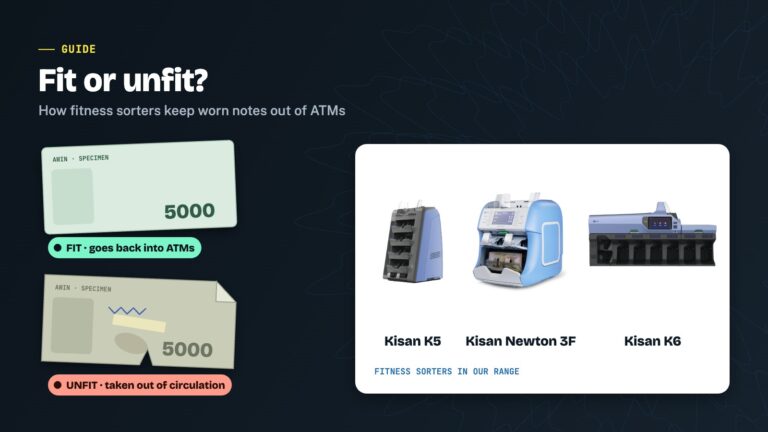
| Cash centre or ATM replenishment | Fitness sorter |
If you would like a recommendation, the machine finder on our homepage asks three questions and suggests models from our range. You can also browse all machines in the shop, or contact our sales team for advice and a quotation.