“Counting machine” covers two quite different kinds of machine. A piece counter tells you how many notes are in a stack. A value counter tells you how much money is in it, even when the notes are mixed. Choosing the wrong one is the most common mistake we see, so here is how they differ and who each one suits.
What a piece counter does
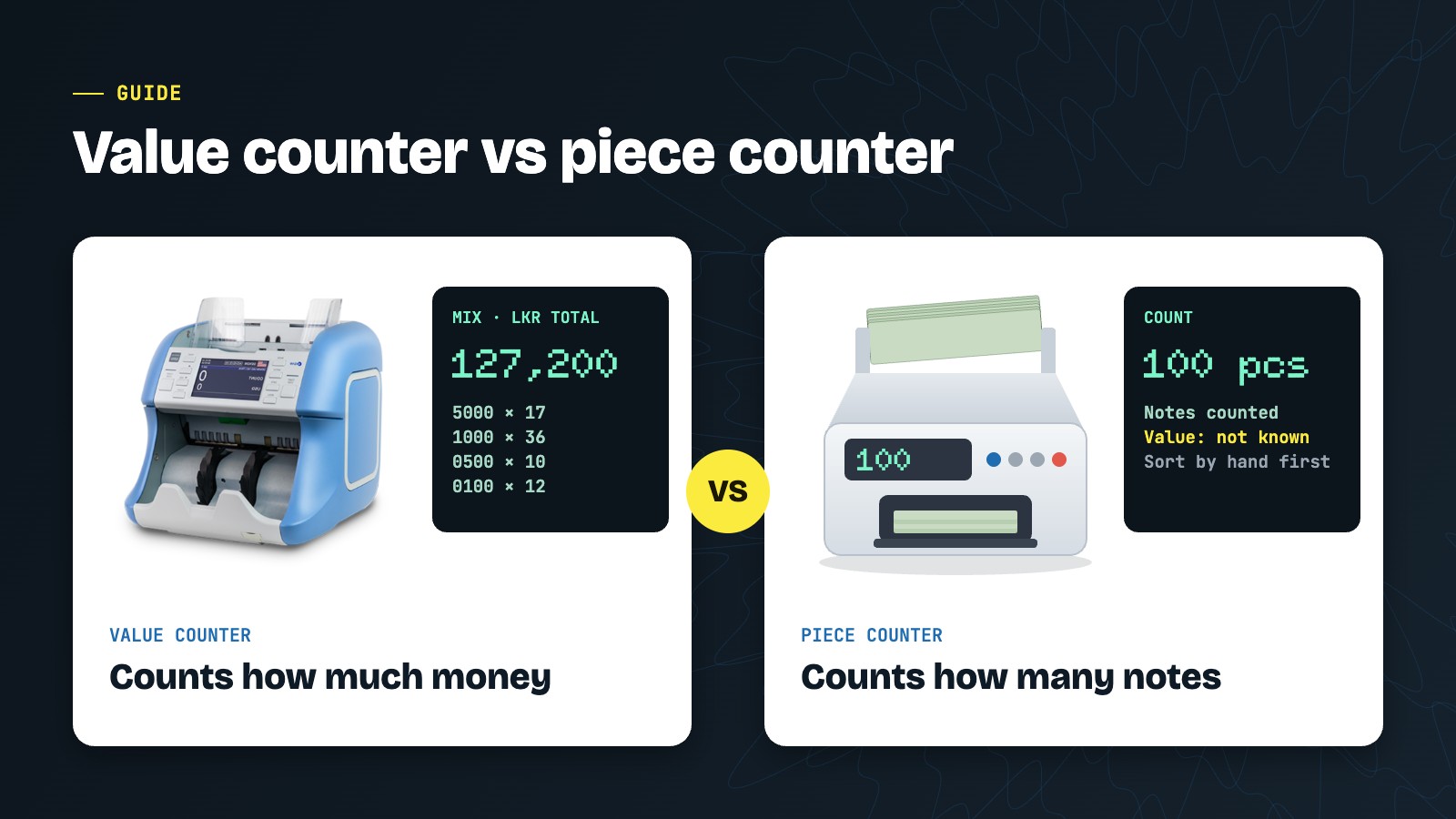
A piece counter feeds notes through and counts them one by one. You get a number, for example “100 notes”. If every note in the stack is a Rs 1,000 note, you know you have Rs 100,000. If someone has slipped a Rs 500 note into the stack, a basic piece counter will still count it as one note.
Most piece counters also check for counterfeits with UV, magnetic (MG) and infrared (IR) sensors, and many have a batch function that stops at a set number, such as 100, so you can make up bundles.
Good for: businesses that already sort notes by denomination by hand, and want fast, accurate counts and basic fake detection.
What a value counter does
A value counter (often called a mixed-value counter) uses image sensors, usually CIS (contact image sensors), to recognise the denomination of every note. You can put a mixed bundle in the hopper and get:
- the total value of the bundle,
- a breakdown by denomination (for example 17 × Rs 5,000, 36 × Rs 1,000, 10 × Rs 500), and
- on many models, a printed or exported report.
Because the machine scans an image of each note, its counterfeit detection is usually stronger too. Higher-end value counters can also read and store serial numbers.
Good for: supermarkets, finance companies, hotels and any business that cashes up mixed takings at the end of a shift.
Side by side
| Piece counter | Value counter | |
|---|---|---|
| Counts number of notes | Yes | Yes |
| Totals the value of mixed notes | No | Yes |
| Breakdown by denomination | No | Yes |
| Counterfeit detection | Usually UV, MG, IR | UV, MG, IR plus image recognition |
| Serial number reading | Rarely | On many models |
| Notes must be pre-sorted | Yes | No |
| Price | Lower | Higher |
What about sorters?
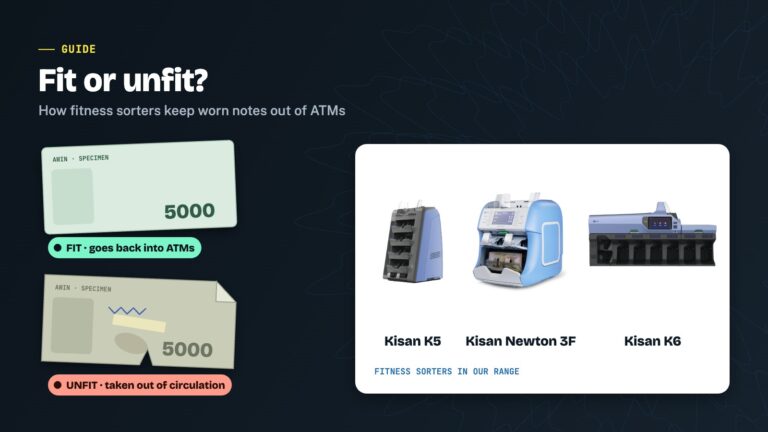
A sorter is a value counter with more than one output pocket. As well as counting a mixed bundle, it can separate notes, for example by denomination, by which way they face, or into a separate pocket for suspect notes, without stopping. A common design is “1+1”: one main pocket and one reject or sorting pocket. Banks and cash centres also use fitness sorters, which separate notes that are too worn to go back into circulation. We explain those in Fitness sorting explained.
How to decide
- Your staff sort notes before counting anyway, and volumes are modest: a piece counter is enough.
- You cash up mixed takings every day: a value counter will pay for itself in time saved and fewer counting errors.
- You need to separate notes as well as count them: look at a two-pocket sorter.
- You need an audit trail: choose a value counter with serial number recognition.
Value counters and sorters in our range
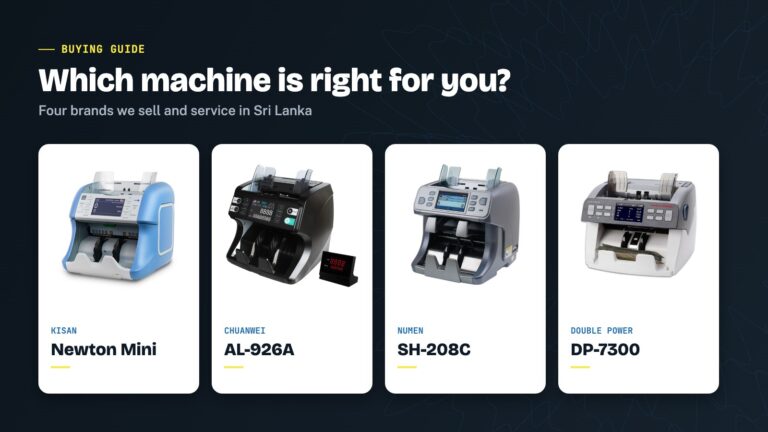
Our mixed-value counters include the Chuanwei AL-926A, the Double Power DP-7300 and the Kisan Newton Mini, which also saves serial numbers. For sorting, see the Chuanwei AL-950A, the Numen SH-208C and the Kisan Newton 3. Prices are listed on each product page.
Still not sure? Read How to choose a cash counting machine, or ask our sales team and tell them how many notes you count each day.