The Rs 5,000 note is the highest-value note in everyday use in Sri Lanka, which makes it the one counterfeiters target most. The good news is that the genuine note carries security features you can check in a few seconds, without any equipment. This guide covers the features published by the Central Bank of Sri Lanka (CBSL) for the current note series, grouped by how you check them: look, tilt and feel.
The most important rule comes from the Central Bank itself: never rely on just one feature. A good fake may copy one or two. It is very hard to copy them all.
Look: hold the note up to the light
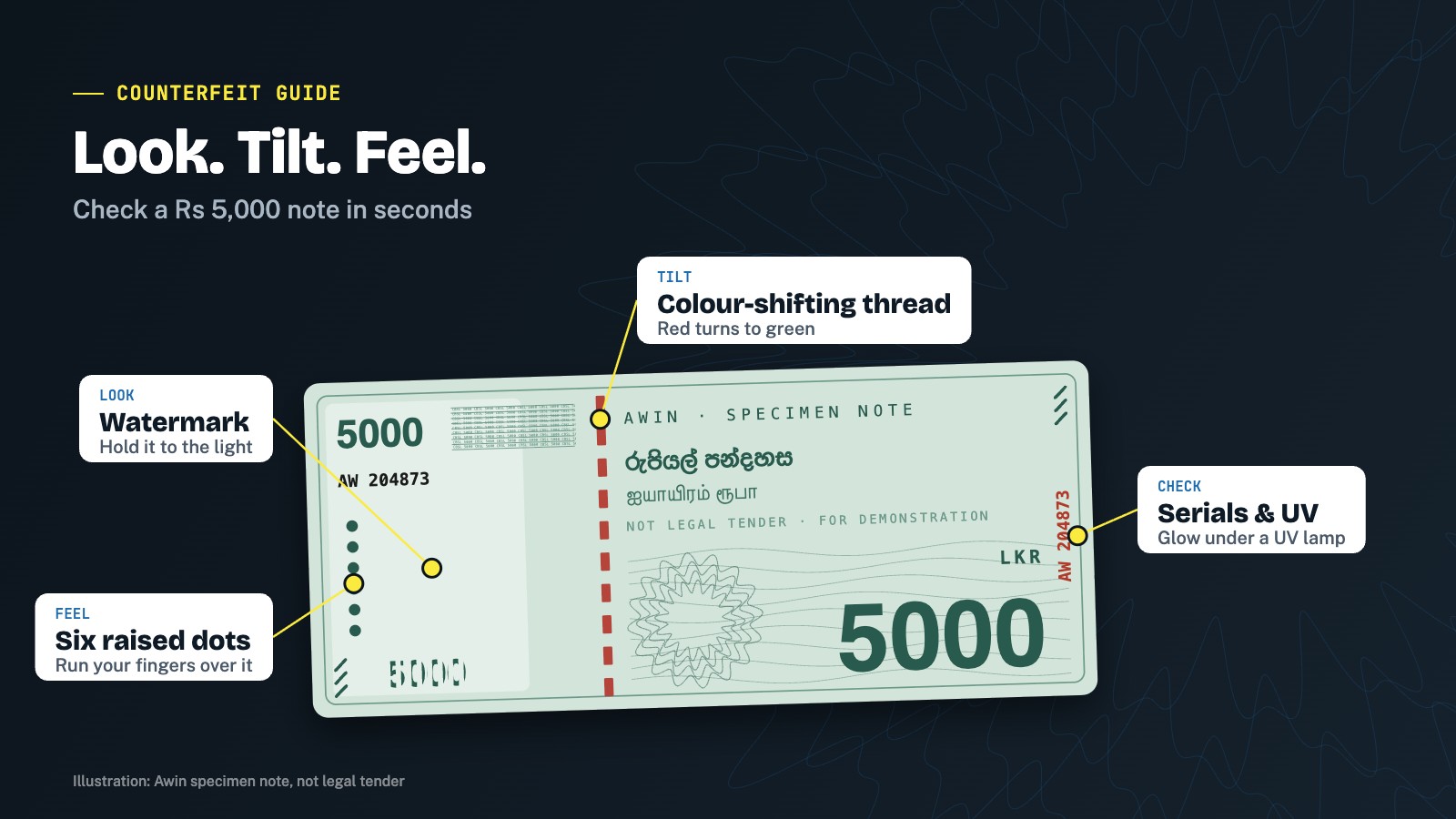
- Bird watermark. Each note has a watermark of the same bird that is printed on the note. On the Rs 5,000 it is the Sri Lanka Yellow-eared Bulbul. It sits in the paper itself, so it is only visible against the light and cannot be felt.
- Highlighted “5000”. Next to the bird, the value appears vertically as a highlighted watermark that looks lighter than the paper around it.
- Cornerstone® bars. Diagonal bars appear in every corner of every genuine note. They are made in the paper, not printed on it.
- See-through numeral. Part of a numeral is printed on the front and part on the back. Held to the light, the two halves line up exactly into one complete number. On fakes they often don’t line up.
- Security thread. A thread runs through the paper carrying the letters “CBSL” and the value. Against the light it shows as a continuous line.
Tilt: move the note in the light
- Colour-shifting thread. On the Rs 5,000 the thread is a 3 mm wide windowed Starchrome® thread. It appears in “windows” on the surface of the note and changes colour from red to green as you tilt it. (The Rs 1,000 and Rs 500 have the same type of thread at 2.5 mm and 2 mm.)
- Latent image. The Central Bank lists a latent image among the note’s features. It is a hidden numeral within a patch of fine lines that only appears when you hold the note at eye level and tilt it.
Feel: run your fingers over the note
- Raised print. The Central Bank title, the main images and other areas are printed in raised ink you can feel with your fingertips. Fakes printed on ordinary printers feel flat and smooth.
- Tactile bars. Short raised lines printed into the note that you can feel with your fingertips.
- Dots for the visually impaired. A column of heavily printed dots on the left side helps blind and partially sighted people identify the value. The number of dots goes up with the denomination, starting with one on the Rs 20, so the Rs 5,000 has six.
- The paper. Genuine notes are printed on special currency paper that feels crisp and slightly rough, not soft or waxy.
Look closely: tiny text
Viewed closely, or with a magnifier, the note carries extra-small text reading “CBSL” and the value. On many fakes this text is blurred or appears as a solid line.
Under UV light
The Central Bank also lists fluorescent features. Under an ultraviolet lamp, genuine notes show specific fibres and printed areas that glow, while the paper itself stays dull. Fakes printed on ordinary paper often glow a bright blue-white all over. A small UV lamp is an inexpensive extra check at the counter.
What a counting machine checks
Checking every note by hand is not practical when you are counting hundreds of them. A good counting machine checks each note in a fraction of a second, using a combination of:
- UV sensors for the fluorescent response of the paper and print,
- magnetic (MG) sensors for magnetic ink,
- infrared (IR) sensors for patterns invisible to the eye, and
- CIS image sensors that compare an image of each note against the genuine design.
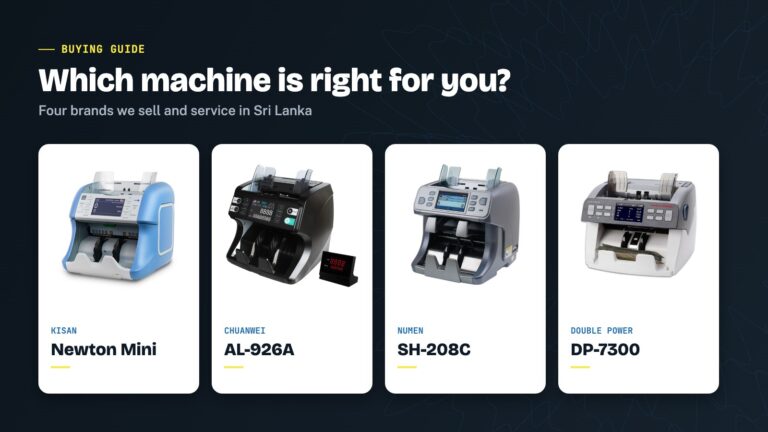
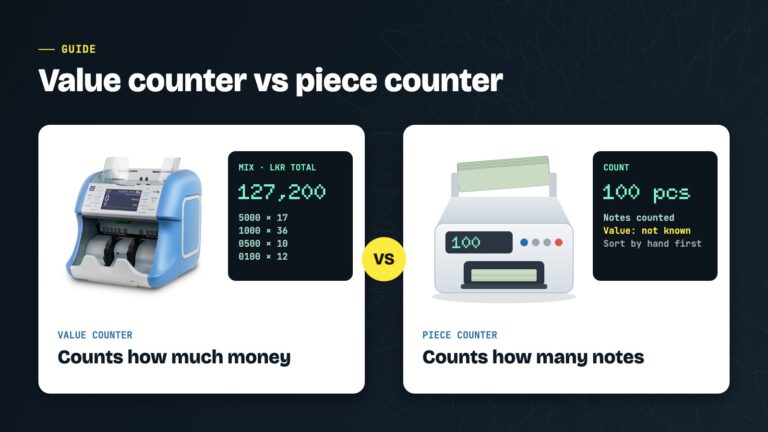
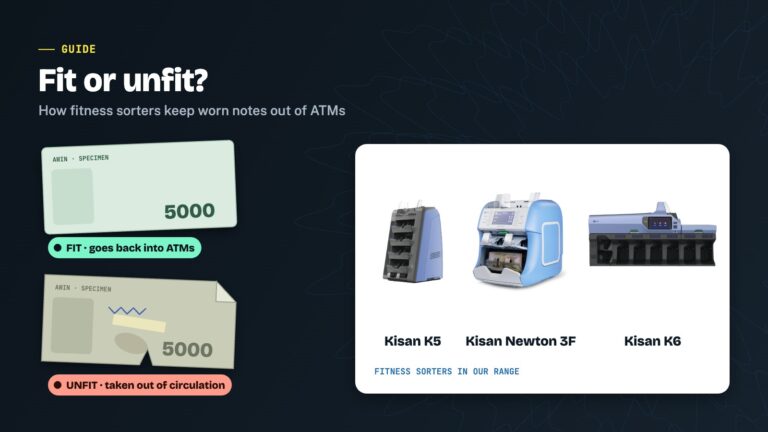
Suspect notes are stopped or sent to a separate reject pocket, so they never end up in your bundles. Machines need their currency data updated when the Central Bank issues a new note, so make sure your supplier can do this. You can see which machines we stock in our shop, and read How to choose a cash counting machine for help deciding what level of detection you need.
If you think a note is fake
- Check several of the features above, not just one.
- Do not pass the note on. The Central Bank notes that it is an offence to deface or imitate a currency note.
- Ask your bank for advice, or report it to the police.
- For questions about currency, contact the Central Bank of Sri Lanka’s Currency Department on +94 11 2477587 or currency@cbsl.lk.
Want to see these features for yourself? The interactive “Detection lab” on our homepage lets you explore each one on a specimen note, with views for light, tilt, UV and magnification.
Source: Central Bank of Sri Lanka, currency security features and “Make sure your currency notes are genuine” notice. This guide is for general information; for official guidance, refer to the Central Bank of Sri Lanka.